
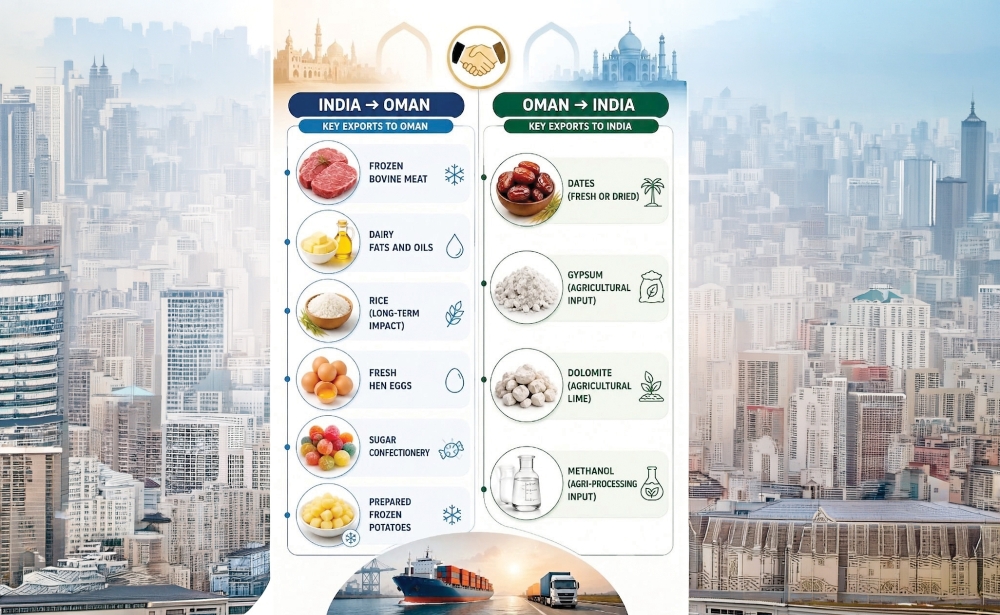





Researchers at the Department of Natural Resource Economics, College of Agricultural and Marine Sciences, Sultan Qaboos University (SQU) have urged Oman to complement the Oman-India Comprehensive Economic Partnership Agreement (CEPA) with targeted investments in domestic agriculture, logistics and food supply resilience if the landmark trade pact is to deliver balanced long-term benefits for the Sultanate of Oman.
In a new study titled, ‘Who Gains and How? Agri-Food Trade Outcomes of the Oman–India CEPA’, published in the Journal of Agricultural and Marine Sciences, Dr Osman Gulseven, Dr Lokman Zaibet and Dr Ibtisam al Abri conclude that while CEPA will generate significant trade gains for both countries, Oman must take proactive measures to avoid becoming increasingly dependent on Indian food imports and to capitalise on new export opportunities.
Using product-level simulations based on the agreement's tariff commitments and 2024 trade data, the researchers found that bilateral trade will expand considerably following tariff liberalisation. However, the benefits are expected to be unevenly distributed.
While Oman's exports to India are projected to increase by around $567 million, these gains remain concentrated in a relatively small number of energy, fertiliser and chemical products. India, by contrast, is expected to increase exports to Oman by roughly $657 million across a much broader range of nearly 2,800 product lines, including numerous food products.
But rather than fundamentally reshaping trade patterns, the agreement is expected to reinforce existing comparative advantages, the paper warns.
For Oman, the study argues, this makes complementary policy interventions essential. Foremost among the recommendations is strengthening domestic agricultural production and supply capacity. According to the researchers, tariff reductions alone will not enable Omani producers to diversify exports unless they are supported by investments that improve productivity, scale and competitiveness.
The authors also call for greater emphasis on meeting international quality, food safety and phytosanitary standards, enabling Omani producers to take fuller advantage of preferential access to India's vast consumer market. At present, dates remain the only food product with significant export growth potential under CEPA, with simulations indicating that duty-free access could substantially boost shipments to India.
Another priority identified in the paper is investment in logistics infrastructure. Improving cold-chain facilities, storage capacity, transport networks and port logistics would not only strengthen food imports but also help Omani agricultural producers compete more effectively in export markets, particularly for perishable products.
The researchers also recommend closer regulatory cooperation with India, particularly on sanitary and phytosanitary (SPS) measures, veterinary certification, food labelling and quality assurance. Such cooperation would reduce non-tariff barriers that frequently constrain agricultural trade even after tariffs have been eliminated, they point out.
While CEPA is expected to improve access to protein products, dairy ingredients and processed foods from India, the researchers caution that Oman should guard against excessive concentration of food imports from a single supplier.
Instead of reversing trade liberalisation, they advocate managing concentration risk through supplier diversification, strategic food reserves and stronger resilience planning for critical food commodities.
These measures, they argue, would help protect the Sultanate against future disruptions to global food supply chains while preserving the benefits of deeper economic integration.
The study notes that CEPA is likely to strengthen India's position as one of Oman's principal agri-food suppliers, particularly in products such as frozen meat, dairy fats, processed foods and eggs. However, the researchers found little evidence that tariff reductions alone will significantly diversify Oman's agricultural exports beyond niche products.
"The agreement appears more likely to reinforce existing sourcing patterns than to create a substantially more diversified agri-food trade structure," the authors observe, arguing that the quality of implementation will ultimately determine whether CEPA contributes to long-term food security and sustainable economic development.
The researchers stress that Oman should view CEPA not simply as a tariff-reduction exercise but as an opportunity to strengthen the country's food system and export competitiveness.
Strategic investments in agricultural production, logistics, standards compliance and supply-chain resilience would allow the Sultanate of Oman to maximise the agreement's economic benefits while reducing vulnerabilities associated with rising food import dependence.
Ultimately, they conclude, CEPA's long-term success for Oman will depend less on tariff preferences themselves than on the complementary domestic policies that enable businesses to exploit new market opportunities and build a more diversified and resilient agri-food sector.
Oman Observer is now on the WhatsApp channel. Click here